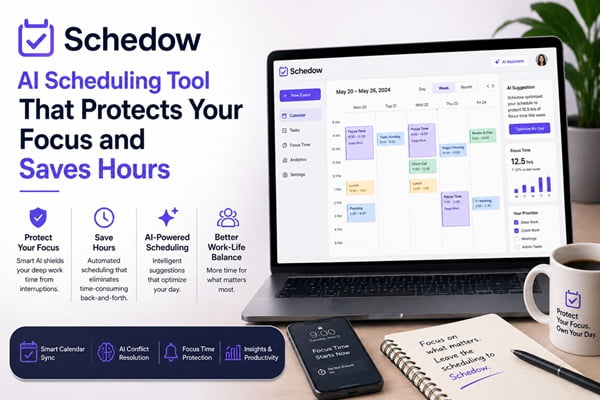
You have a calendar full of meetings. Your to do list keeps growing. And somehow, you end each day feeling like you accomplished nothing important. This is not a personal failing. It is a system failure. Most scheduling tools only show you where time goes. They do not help you spend it better. Schedow changes that completely.
Schedow is an AI powered scheduling platform that does more than book meetings. It actively manages your time, protects your focus, and aligns your calendar with what actually matters. Unlike basic calendar apps that simply display events, Schedow thinks, learns, and adapts to how you work. It knows when you are most productive. It understands which meetings need deep focus and which need quick collaboration. And it schedules accordingly.
What Schedow Actually Does
The name Schedow combines scheduling with how. It asks not just when a meeting happens but how it fits into your broader workflow. Most scheduling tools treat every hour as equal. Schedow knows better. An hour of deep work before lunch is not the same as an hour of scattered meetings after lunch. The platform protects your peak performance windows and pushes less important activities to lower energy times.
Schedow automates the entire scheduling lifecycle. Availability detection happens instantly. Meeting coordination requires no back and forth emails. Reminders send automatically. Rescheduling happens without manual intervention. And performance analysis shows you exactly how your time gets spent. The system handles all of this in the background so you can focus on actual work.
Why Traditional Scheduling Keeps Failing You
Paper planners and basic digital calendars share the same flaw. They are passive. You write something down or add an event, and the calendar simply stores that information. It does not question whether that meeting belongs at that time. It does not protect your focus hours. It does not learn from your behavior.
This passive approach creates several problems. Overbooking happens constantly because nothing warns you about scheduling too many meetings in one day. Context switching destroys productivity because meetings get sprinkled randomly throughout your best work hours. Rescheduling becomes a nightmare of email chains and conflicting availability. And no one tracks whether all those meetings actually produced value.
Traditional calendars also ignore how humans actually work. Energy levels fluctuate throughout the day. Some tasks require deep concentration. Others need only quick attention. A good scheduling system accounts for these differences. A basic calendar ignores them entirely.
The Philosophy Behind Schedow
Three core principles guide how Schedow works. First, time is a limited resource. Every hour you spend in a meeting is an hour you cannot spend on deep work, strategic thinking, or simply resting. Poor scheduling leads directly to burnout, stress, and reduced output. Schedow treats your time as valuable because it is.
Second, balance matters more than busyness. Filling every calendar slot with meetings does not make you productive. It makes you exhausted. Real productivity comes from creating space for thinking, execution, and recovery. Schedow actively protects focus time and discourages unnecessary scheduling density.
Third, scheduling is a team sport. Modern work involves collaboration across departments, time zones, and cultures. Schedow recognizes that your calendar does not exist in isolation. It balances individual preferences with team needs, ensuring smooth coordination without sacrificing personal work rhythms.
How Schedow Learns Your Work Patterns
The platform studies your historical calendar data. It notices when you schedule meetings and when you block focus time. It tracks how long different types of meetings typically last. It observes which times of day you complete your most important work.
Over time, Schedow builds a profile of your productivity patterns. It learns that you write reports best between nine and eleven in the morning. It remembers that you handle administrative tasks better after lunch. It notices that Friday afternoons work well for team check ins but poorly for strategic planning.
Using this profile, Schedow makes intelligent suggestions. When someone tries to book a meeting during your peak focus window, the system either blocks that time or suggests alternative slots. When your calendar gets too crowded, Schedow warns you before you overcommit. When energy levels dip, it recommends lighter activities.
Core Features That Make Schedow Different
Smart time optimization stands as the most powerful feature. Instead of simply displaying available slots, Schedow actively protects your best work hours. It understands that not all time is equal. A ninety minute creative block deserves protection. A thirty minute window between meetings works well for quick catch ups. The system learns these distinctions and schedules accordingly.
Seamless integrations connect Schedow to the tools you already use. Google Calendar, Microsoft Outlook, Zoom, Slack, and Microsoft Teams all sync automatically. Changes made in one platform update everywhere instantly. No double booking. No missed updates. No manual syncing across different apps.
Automated rescheduling handles plan changes without stress. When a meeting runs late or gets cancelled, Schedow notifies all participants, finds new time slots, and sends updated invitations. No email chains. No back and forth negotiations. No wasted time trying to find a new time that works for everyone.
The team coordination dashboard balances transparency with privacy. Team members see overall availability and workload distribution without exposing personal calendar details. Managers identify overloaded employees before burnout happens. Color coded timelines make decision making faster and clearer.
Focus mode silences notifications during deep work sessions. It syncs with device level do not disturb settings. Instead of constant interruptions, you receive alerts only when they matter most. Your concentration stays intact while you stay informed.
Setting Up Schedow for the First Time
Getting started takes minutes, not hours. You sign up for an account and connect your existing calendars. The platform supports Google Calendar, Outlook, and other major services. Once connected, Schedow analyzes your current schedule to understand your patterns.
Next, you set your working hours and preferences. Define when you start and end your day. Block out lunch breaks and personal time. Specify which hours you reserve for deep work. Tell the system which meeting types need different durations or settings.
After setup, Schedow generates booking links you can share with colleagues, clients, or anyone who needs to meet with you. When someone clicks your link, they see only the times you have made available. They book a slot that works for both of you. No negotiation required.
The system begins learning immediately. Each meeting you accept or decline teaches Schedow more about your preferences. Each reschedule refines its understanding of your availability. Over weeks and months, the platform becomes remarkably accurate at predicting your ideal schedule.
How Different People Use Schedow
Freelancers juggle multiple clients with conflicting demands. Schedow helps them manage client bookings without overcommitting. Each client gets a customized booking link showing only relevant availability. Automatic reminders reduce no shows. And the calendar stays organized across every project.
Small business owners wear many hats throughout the day. Schedow protects their strategic thinking time while keeping customer meetings accessible. The platform distinguishes between internal planning sessions and external client calls, scheduling each type at optimal times.
Remote teams spread across time zones face unique coordination challenges. Schedow automatically adjusts for time differences, suggesting meeting times that work for everyone. It respects local working hours in each region. No one gets forced into late night or early morning calls unless absolutely necessary.
Service providers like coaches, consultants, and therapists use Schedow to offer professional booking experiences. Clients self schedule through customized links. Payment integrations allow upfront billing. Automated reminders dramatically reduce last minute cancellations.
Students balance classes, study sessions, and personal time. Schedow helps them create realistic study schedules that align with their energy patterns. Assignment deadlines link directly to calendar blocks. The system prevents overloading and protects rest time.
Protecting Your Data and Privacy
Schedow takes security seriously. Enterprise grade encryption protects all data in transit and at rest. GDPR compliance ensures privacy rights for users in Europe and beyond. You control exactly what calendar information gets shared with whom.
Role based access controls let teams define permissions carefully. Administrators see team wide availability. Individual contributors share only necessary details. Audit logs track who accessed what information and when.
No third party sells your scheduling data. No advertisers target you based on your calendar. Schedow exists to serve you, not to monetize your information. This commitment to privacy separates the platform from free alternatives that profit from user data.
Measuring What Matters
Analytics reveal how your time actually gets spent. Schedow tracks meeting load, focus time allocation, and scheduling inefficiencies. You see exactly how many hours go to different meeting types. You discover which times of day produce your best work. You identify patterns that waste time and opportunities to improve.
These insights empower continuous improvement. Maybe you realize that hour long meetings rarely need the full sixty minutes. Perhaps you notice that back to back calls destroy your afternoon productivity. Data gives you permission to change these patterns because you can prove their impact.
Teams benefit from aggregated analytics without sacrificing individual privacy. Managers see overall trends like excessive meeting culture or poor cross time zone coordination. These insights drive organizational changes that benefit everyone.
Also Read : FSI Blogs US: Why Finance Pros Trust These Industry Insights
Comparing Schedow to Other Options
Basic calendar apps like Google Calendar or Outlook show events but offer no intelligence. They display your schedule but do not help you improve it. Schedow actively manages your time rather than passively recording it.
Simple scheduling links like Calendly automate booking but stop there. They help people find time on your calendar but offer no ongoing schedule optimization. Schedow combines booking automation with continuous intelligence about your work patterns.
Team scheduling tools like Doodle focus on group coordination but lack personal productivity features. Schedow bridges both worlds, helping individuals and teams simultaneously.
Project management platforms track tasks but ignore calendar optimization. Schedow connects your to do list to your schedule, ensuring important tasks get the time they need.
Common Questions About Schedow
Many people wonder if Schedow works offline. The platform requires internet connectivity for real time syncing and AI features, but your calendar data remains accessible on your device even without connection. Changes sync automatically when you reconnect.
Others ask about pricing. Schedow offers different tiers based on needs. Individual plans work for freelancers and solo professionals. Team plans add coordination features and shared dashboards. Enterprise plans include advanced security and administrative controls.
Some worry about losing control to automation. Schedow always allows manual overrides. The system suggests optimal times but never forces them. You remain the final decision maker for your calendar.
Questions about mobile access come up frequently. Schedow works across desktop browsers and mobile devices. The mobile app includes all core features, letting you manage schedules, accept bookings, and check analytics from anywhere.
The Future of Schedow
Development continues on several fronts. Predictive scheduling will soon suggest meeting times based on urgency and importance, not just availability. Voice assistant integration will let you manage schedules through natural language commands. Wellness aware scheduling will consider biometric data to protect your energy and mental health.
Expanded smart device compatibility will connect Schedow to office displays, meeting room systems, and wearable devices. Your calendar will exist everywhere you need it, not just on your phone or computer.
Machine learning improvements will make the platform increasingly accurate. Schedow will predict your preferences before you articulate them. It will identify productivity patterns you never noticed yourself. It will become not just a tool but a trusted partner in how you work.
Schedow represents a fundamental shift in scheduling. Instead of managing your time reactively, you take control proactively. Instead of feeling overwhelmed by your calendar, you feel confident about your day. The platform handles the complexity so you can focus on the work that matters. For anyone tired of watching time slip away in poorly planned meetings and scattered focus, Schedow offers a better way forward.