You have heard terms like AI, automation, and real time data. But how do they all fit together? Many businesses have information scattered across different departments. Sales uses one tool. HR uses another. Customer support uses a third. These systems do not talk to each other.
Cñims offers a solution. It stands for Coordinated Networked Intelligent Management Systems. That is a long phrase, but the idea is simple. Cñims connects different parts of an organization into one smart, responsive system.
This emerging concept is gaining attention because it solves a real problem. Too much data. Slow decisions. Disconnected tools. Cñims addresses all of these by combining real time analytics, artificial intelligence, and automation in a single framework. This article explains everything about Cñims, how it works, where it is used, and why it matters.
What Is Cñims
Cñims is best understood as a smart system that connects data, digital networks, artificial intelligence, and decision making. Because the term is still developing, different interpretations exist. But they all point in the same direction.
In simple words, Cñims can be described as a connected system that gathers information, studies it, and helps people or organizations take better action. Instead of letting data sit in separate places, Cñims brings it together and makes it useful.
Think of it like a smart brain for a company, platform, or communication system. It does not just store information. It understands patterns, supports decisions, and helps automate work that would otherwise take more time and effort. This is why Cñims fits so well into the age of AI and digital transformation.
Simple Example of Cñims
Imagine a hospital using one system to read patient records, staff schedules, room availability, and emergency trends. That system can help predict how many patients may arrive and prepare the staff in advance.
In a store, Cñims could study buying patterns and predict which products will sell more next week. In a company office, it could connect employee data, project updates, and business reports so managers can make faster and smarter decisions.
These examples show the practical value. Cñims turns raw information into useful action.
History and Origin
The idea behind Cñims did not appear all at once. It grew from the broader evolution of data systems over the last two decades.
In the early 2000s, many businesses began using basic digital tools to collect and store information. These early systems were useful, but they were often slow, limited, and separated from each other. One department had one tool. Another department had a different one. Very little communication happened between them.
During the 2010s, cloud computing changed everything. Businesses started using connected platforms, online databases, and shared systems that allowed better access to information. This was a major step toward connected intelligence.
Then, in the 2020s, AI, machine learning, and automation became much more common. Companies wanted systems that could do more than store data. They wanted systems that could understand trends, make predictions, and support decisions in real time.
Cñims emerged as a response to modern digital pressure. Businesses were dealing with too much data, slow decision making, disconnected systems, and increasing demand for instant insights.
How Cñims Works
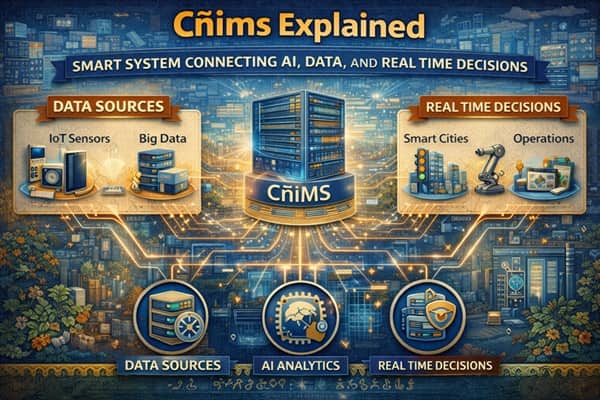
Cñims works by taking information from different sources, analyzing it, and turning it into actions, recommendations, or automated responses. It is a connected flow of information and intelligence rather than a single isolated tool.
The process begins with data collection. Cñims gathers information from apps, websites, sensors, devices, databases, employee systems, customer platforms, and many other sources. This gives the system a broad and updated view of what is happening.
After collection, the system processes the data. This is where AI and data analysis come in. Cñims can organize raw information, remove errors, compare trends, and identify patterns that humans may miss in large datasets.
Once the information is analyzed, the decision engine suggests useful actions. It may recommend increasing stock, adjusting staff schedules, improving customer support timing, or checking a security risk.
In more advanced environments, Cñims can also automate actions. It may send alerts, update dashboards, schedule tasks, or trigger other connected systems without waiting for manual input.
Cñims becomes stronger over time because it learns from new information. With machine learning, it improves predictions, understands behavior better, and supports smarter decisions in the future.
Main Features
One reason Cñims stands out is that it combines several important digital capabilities into one connected system.
Real time analytics allows users to see current information instead of waiting for delayed reports. In fast industries, this can make a huge difference.
AI automation reduces routine manual work by handling repeated tasks, tracking patterns, and responding to changes more quickly than traditional systems.
Cñims is often linked with cloud and edge computing. The cloud helps with storage, access, and large scale processing. Edge systems help analyze information closer to the source, reducing delays.
Its modular structure is another strong feature. Organizations can use only the parts they need and expand later. API integration helps Cñims connect different tools, apps, and platforms into one working environment.
Dashboards make information easier to read. Predictive analytics helps users see likely future outcomes instead of only current conditions. Data security is also important, since modern systems must protect sensitive information.
The most powerful feature may be real time decision making. Instead of collecting information and reviewing it later, the system helps organizations react while events are happening.
Uses in Different Industries
Cñims can be useful in many industries because almost every modern sector depends on data, communication, and fast decisions.
In healthcare, Cñims can help hospitals predict patient flow, manage staff schedules, organize records, and support faster planning during emergencies. This improves care and helps hospitals use resources more wisely.
In banking and finance, Cñims can study transactions in real time, detect unusual activity, reduce fraud risks, and improve financial forecasting. It can also support smarter lending, risk analysis, and customer service.
In retail, Cñims helps businesses understand customer behavior, predict product demand, and manage stock more efficiently. This reduces waste and prevents empty shelves.
In manufacturing, it can monitor equipment, predict machine failure, and help managers avoid costly downtime. This is especially useful in factories where delays can affect production targets.
Telecom companies can use Cñims to study network usage, improve signal quality, and respond faster to service problems. It helps manage large systems where millions of users depend on stable communication.
In smart cities, Cñims can support traffic management, electricity use, water supply planning, waste systems, and public safety. By connecting different city systems, it helps urban areas become more efficient and responsive.
Benefits
Cñims offers many benefits because it helps organizations move from slow, manual systems to connected and intelligent operations.
Faster decision making is a major benefit. When leaders have real time information, they can act more quickly and with more confidence. This is valuable in industries where even a small delay can cause financial loss or service problems.
Cost reduction is another advantage. By automating repeated tasks and improving efficiency, Cñims can lower operational waste and reduce the need for extra manual work.
Better productivity means teams spend less time collecting information and more time using it. Customer experience can also improve when systems respond faster and understand user needs more accurately.
Cñims supports future planning. Instead of only showing what happened in the past, it helps organizations predict trends, prepare for demand changes, and reduce risk.
Reducing human error is another benefit. When data is handled by smart systems with built in checks, mistakes caused by delay, confusion, or missed details become less common.
Limitations and Challenges
Even though Cñims offers strong benefits, it also comes with challenges.
Cost is a major issue. Advanced systems that use AI, data integration, automation, and security controls can be expensive to build and maintain. This can make adoption difficult for small businesses with limited budgets.
Skilled people are needed. A system like Cñims may require experts in data, software, cybersecurity, and operations to manage it properly.
Data privacy is another serious concern. Because Cñims often collects and studies large amounts of information, organizations must be careful about how data is used, stored, and shared.
Cybersecurity is a major challenge. Connected systems can become targets for hackers if protection is weak.
Training is equally important. Employees may struggle at first if they are used to older systems and manual work methods.
System complexity can also slow adoption. If the platform is too complicated, organizations may not use it effectively.
Ethical Issues and Data Privacy
As Cñims becomes more intelligent and connected, ethical questions become more important.
Fairness in AI decisions matters. If a system is trained on poor or biased data, it may produce unfair results. This can affect hiring, customer service, healthcare decisions, or financial evaluations.
Data privacy requires attention. Cñims may handle personal, financial, health, or behavioral information. Users need to know that their data is being treated responsibly.
Transparency also matters. People should understand how the system works, what data it uses, and how decisions are made.
Job automation raises concerns. While Cñims can improve efficiency, some workers may fear being replaced by technology. Instead of replacing people without planning, organizations should focus on using Cñims to support human work.
Cñims and Artificial Intelligence
Artificial intelligence is one of the main reasons Cñims feels modern and relevant. Without AI, Cñims would be closer to a standard digital management system. With AI, it becomes much more powerful.
Machine learning allows the system to study patterns in large datasets and improve over time. Predictive analytics helps it estimate future outcomes, such as customer demand, patient volume, or equipment failure.
Automation is another area where AI strengthens Cñims. Instead of waiting for human input at every step, the system can identify events and respond quickly.
The best way to understand Cñims is as a form of human and AI collaboration. The system handles speed, scale, and pattern recognition. People provide judgment, ethics, creativity, and strategic thinking.
Also Read : Darlnaija: Celebrating Nigerian Culture, Afrobeats, Nollywood, and Digital Creativity
Future of Cñims
The future of Cñims looks closely connected to the future of intelligent technology itself. As cities, businesses, and public systems become more digital, the need for connected decision making systems will continue to grow.
In smart cities, Cñims could play a role in traffic control, energy use, water systems, public transport, and emergency planning. In transportation, it may support self driving systems by helping them process road, weather, and traffic data quickly.
In business, Cñims may help create more automated companies where operations, reporting, customer service, and forecasting work together in one intelligent environment.
In healthcare, it could support more personalized treatment by studying patient history, behavior, and medical trends.
The long term direction suggests a move toward more fully automated decision systems. But that future will still need human guidance. Trust, privacy, and responsible design will remain important.
Final Thoughts
Cñims is a modern intelligent system that brings together AI, data, networks, and automation in one connected structure. Even though the term is still emerging, its meaning clearly points toward a smarter way of managing digital information and decision making.
Instead of depending only on manual work and delayed reports, Cñims helps organizations act in real time, understand patterns, reduce waste, and improve performance. That is why it fits so well into the future of business, healthcare, finance, and smart cities.
The real strength of Cñims is that it combines different technologies into a practical system that supports better choices. It can improve productivity, lower errors, and help organizations respond faster to changing needs.
At the same time, it requires careful planning, ethical use, and strong data protection. As digital transformation continues, Cñims is likely to become more important. Organizations that understand and adopt this kind of intelligent system early may be better prepared for future growth and success.