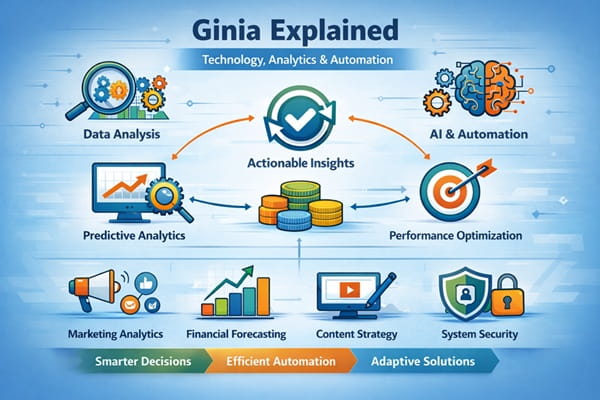
Ginia is a term that has started to appear across different online platforms, often linked with digital systems, smart tools, and evolving technologies. Many people come across it without a clear explanation, which creates confusion. Ginia is not tied to a single company or product. It is better understood as a system concept or a flexible framework that supports data-driven processes and intelligent automation.
At its core, Ginia focuses on improving how systems collect, process, and use information. It helps turn scattered data into meaningful insights that can guide decisions. Once you see Ginia as a structure rather than a single tool, it becomes much easier to understand its role and importance.
The Background and Development of Ginia
Ginia did not appear out of nowhere. It grew from the increasing need for better data handling. As digital platforms expanded, they began generating huge volumes of information. Businesses and developers needed systems that could not only store this data but also make sense of it quickly.
Early solutions focused on reporting. They showed what had already happened but did not offer much guidance for the future. Ginia evolved to solve this gap. It introduced smarter processing, faster analysis, and more actionable outputs. Over time, it became associated with systems that combine analytics, automation, and adaptive learning.
How Ginia Works in Practical Terms
Ginia works through a structured flow that connects data collection, analysis, and decision support. The first stage involves gathering data from different sources. This could include user activity, system logs, transactions, or external inputs.
The second stage focuses on processing that data. Ginia frameworks use algorithms or rule-based systems to organize and analyze information. This step is where raw data starts to become meaningful.
The final stage delivers insights. These insights are not just numbers on a screen. They are designed to guide action. Whether it is improving performance, adjusting strategies, or identifying risks, Ginia helps users take clear next steps.
Key Features That Define Ginia Systems
One of the defining features of Ginia is clarity. It reduces complex data into simple patterns that are easy to understand. This makes it useful for both technical and non-technical users.
Adaptability is another important feature. Ginia systems can adjust based on new data. As conditions change, the system updates its analysis. This keeps the output relevant and accurate over time.
Automation also plays a major role. Many Ginia-based systems automate repetitive tasks. This reduces manual effort and allows teams to focus on strategy instead of routine analysis.
Another strong feature is scalability. Ginia can handle growing amounts of data without losing efficiency. This makes it suitable for both small setups and large enterprises.
Ginia Compared to Traditional Systems
Traditional systems focus on reporting past performance. They provide useful information but often require manual interpretation. Ginia takes a different approach by combining analysis with guidance.
Instead of just showing results, it helps predict outcomes and recommend actions. This shift from passive reporting to active decision support is what sets Ginia apart.
Another difference lies in speed. Ginia systems are designed for faster processing. This allows users to access insights in real time or near real time, which is critical in fast-moving environments.
Real World Use Cases of Ginia
Ginia is used in several practical areas, even if the term itself is not always visible to end users. In digital marketing, Ginia frameworks help track user behavior and campaign performance. They identify which strategies work best and suggest improvements.
In finance, Ginia supports analysis and forecasting. It helps professionals understand trends and make informed decisions based on data patterns.
Content platforms also benefit from Ginia. These systems analyze audience engagement and recommend content strategies. This helps creators produce material that connects better with their audience.
In technical environments, Ginia helps optimize system performance. It monitors operations, identifies inefficiencies, and suggests ways to improve stability and speed.
Role of Ginia in Automation and Intelligence
Automation is at the heart of Ginia. It reduces the need for manual intervention by handling repetitive tasks automatically. This improves efficiency and reduces the chance of errors.
Ginia also supports intelligent systems. By analyzing patterns and learning from data, it can improve its recommendations over time. This makes it a valuable part of modern smart platforms.
The combination of automation and intelligence allows Ginia to act as more than just a tool. It becomes a system that actively supports decision-making.
Benefits of Using Ginia in Digital Systems
The most noticeable benefit of Ginia is better decision-making. By providing clear and actionable insights, it helps users make informed choices quickly.
Time savings is another major advantage. Automated analysis reduces the workload on teams and speeds up processes. This leads to higher productivity.
Ginia also improves accuracy. By relying on data rather than assumptions, it reduces the risk of errors. This is especially important in areas like finance and system management.
Another benefit is flexibility. Ginia systems can be adapted to different needs and industries. This makes them a versatile solution for various use cases.
Challenges and Limitations of Ginia
While Ginia offers many advantages, it also comes with challenges. One of the main issues is data quality. The system depends on accurate data to produce reliable insights. Poor data can lead to incorrect conclusions.
Implementation can also be complex. Setting up a Ginia system requires planning and technical knowledge. Without proper setup, the system may not perform as expected.
Another challenge is interpretation. Even though Ginia simplifies data, users still need to understand the insights. Misinterpretation can lead to wrong decisions.
Privacy is another concern. Since Ginia systems often handle large amounts of data, it is important to follow proper data protection practices.
Future Trends and Growth of Ginia
The future of Ginia looks strong as digital systems continue to evolve. Advances in artificial intelligence will improve its ability to analyze data and generate insights.
Personalization is likely to become more important. Future Ginia systems may provide more tailored recommendations based on individual user behavior.
Integration will also play a key role. As more platforms adopt similar frameworks, the ability to connect and share data will become essential.
Real time analysis will continue to grow. Users expect immediate insights, and Ginia systems are well positioned to meet this demand.
Also Read : Mutmax Explained: Meaning, Uses, Benefits, and Complete Guide
How to Get Started With Ginia Systems
If you are planning to use a Ginia-based system, start by defining your goals. Know what you want to achieve and how the system can support those objectives.
Choose tools that match your needs. Look for platforms that offer clear insights and easy usability. Not all systems are the same, so careful selection is important.
Training is essential. Make sure your team understands how to use the system effectively. This ensures you get the maximum benefit.
Regular monitoring is also important. Evaluate performance and make adjustments when needed. This keeps the system accurate and efficient.
Why Ginia Is Important for the Future
Ginia reflects a shift toward smarter and more efficient systems. It shows how data can be used not just for analysis but for action.
Its ability to simplify complexity makes it valuable in a world filled with information. It helps users focus on what matters and make better decisions.
As more industries adopt data-driven approaches, systems like Ginia will become more important. They provide the tools needed to stay competitive and adapt to change.
Final Thoughts on Ginia
Ginia is not just a trend. It represents a practical approach to handling data and improving decision-making. Its combination of analysis, automation, and adaptability makes it a powerful framework.
When used correctly, Ginia can transform how systems operate. It helps users move from guesswork to informed action. This leads to better results and more efficient processes.
Understanding Ginia gives you a clear advantage. It helps you see how modern systems work and how to use them effectively. That knowledge becomes increasingly valuable as digital environments continue to grow.